
There is a cabin in the mountains of central Norway — hand-hewn timber, stone foundation, maybe 400 square feet — that has survived since the early 1800s. No HVAC system. No spray-foam insulation. No vapor barrier as we would recognize one. And yet the interior stays remarkably temperate through winters that routinely reach -25°C.
The secret is growing on the roof.
A thick mat of living turf — grasses, mosses, wildflowers rooted in compacted earth — has been quietly regulating that cabin's temperature for over two centuries. Not as decoration. Not as a philosophical statement. As a building system. And the science behind why it works is something most modern builders have either forgotten or never learned.
This is the story of the fifth facade — and why architects have been designing it to grow since before the concept of "sustainable design" had a name.
A Roof Is Not Just a Lid
In architectural terminology, we refer to a building's roof plane as the "fifth facade." It is, by area, often the largest single surface of a small structure. On a 600-square-foot cabin with a simple shed roof, the roof plane can exceed 650 square feet of exposed surface — more than any single wall. And yet in conventional construction, this massive thermal interface gets treated as a problem to waterproof and forget.
That is an extraordinary missed opportunity.
The EPA has documented that conventional roof surfaces can reach temperatures 90°F higher than ambient air on a summer afternoon. A dark asphalt shingle roof, fully exposed to solar radiation at 95°F, can exceed 170°F at its surface. That thermal load transfers directly through your roof assembly into your living space, and your mechanical system has to fight every degree of it.
A green roof — even a shallow extensive system with just 4 inches of growing medium — drops that surface temperature by up to 56°F compared to a conventional roof. Not through insulation alone, but through a process called evapotranspiration: the combined effect of water evaporating from the soil substrate and transpiring through plant tissue. It is, effectively, a biological cooling engine that runs on rainwater and sunlight.
And that is just the thermal story. The structural, hydrological, and ecological implications go much deeper.
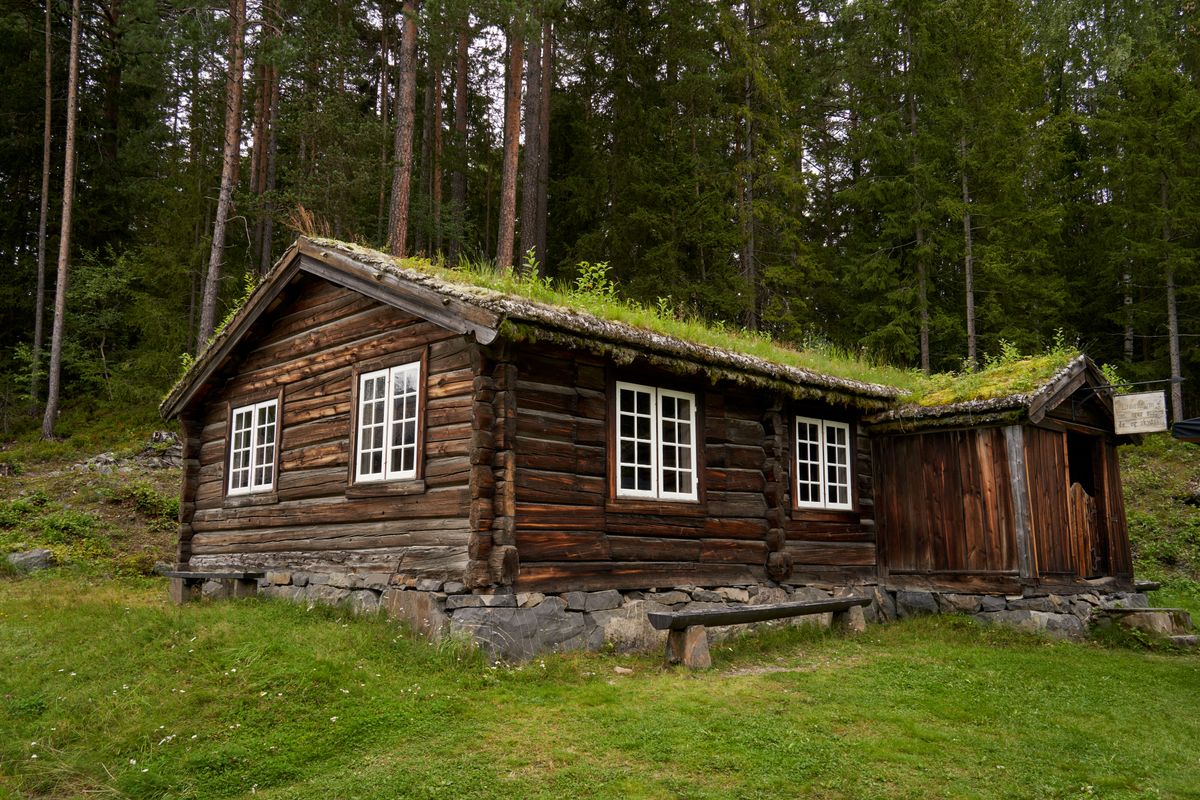
A Scandinavian turf-roof cabin: two centuries of passive thermal regulation, no electricity required.
The Anatomy of a Living Roof
A green roof is not soil dumped on plywood. It is a precisely engineered assembly of interdependent layers, each performing a distinct function. From the structural deck upward, the sequence is:
Waterproofing membrane — typically a modified bitumen or single-ply TPO/EPDM system, often with an integrated root barrier to prevent rhizome penetration. This layer is existential. If it fails, everything above it becomes a liability rather than an asset.
Root barrier — if not integrated into the membrane, a separate polyethylene or polypropylene sheet prevents root intrusion. Some plant species, particularly grasses with aggressive rhizome networks, can puncture standard roofing membranes within a few growing seasons.
Drainage layer — a dimpled plastic sheet, expanded clay aggregate (like LECA), or geocomposite mat that allows excess water to flow laterally toward roof drains while maintaining an air gap beneath the growing medium. This layer is critical in preventing hydrostatic pressure buildup against the membrane.
Filter fabric — a geotextile that prevents fine soil particles from migrating downward and clogging the drainage layer. Without it, the drainage function degrades within a few years.
Growing medium — not topsoil. Engineered substrate, typically a blend of expanded shale, crusite, pumice, and organic matter calibrated for drainage rate, water retention, weight, and nutrient content. This medium must be light enough when saturated to stay within the structural load capacity and porous enough to drain freely.
Vegetation — selected for climate zone, sun exposure, wind tolerance, and minimal maintenance. Extensive systems favor sedums, sempervivums, and low-growing grasses. Intensive systems can support shrubs and even small trees.
Every layer depends on the one below it. Remove the filter fabric and your drainage fails. Undersize the drainage layer and your waterproofing sits in standing water. Use garden soil instead of engineered media and you have doubled your saturated weight, potentially exceeding the structural capacity of your roof framing.
This is why green roofs are not a DIY project. They are an architectural specification.
Extensive vs. Intensive: Weight Is the Deciding Factor
The distinction between extensive and intensive green roofs comes down to one variable that governs everything else: substrate depth.
An extensive system runs 2 to 6 inches of growing medium. Saturated weight lands between 10 and 35 pounds per square foot. A typical residential roof framed with 2×10 rafters at 16 inches on center can often support an extensive green roof with minimal or no structural reinforcement — though this must be verified by a structural engineer for the specific span, species, grade, and loading conditions.
An intensive system runs 8 to 30+ inches of substrate. Saturated weight can reach 80 to 150 pounds per square foot. That is in the range of a second floor's live load. You are no longer designing a roof — you are designing an elevated landscape. The structural implications are significant: heavier framing members, potentially steel support, larger footings, and a completely different connection detailing strategy.
For a cabin in the 400- to 800-square-foot range, an extensive system is almost always the right choice. The thermal benefits are substantial, the weight is manageable, and the maintenance is minimal — typically one or two inspections per year and an occasional weeding.
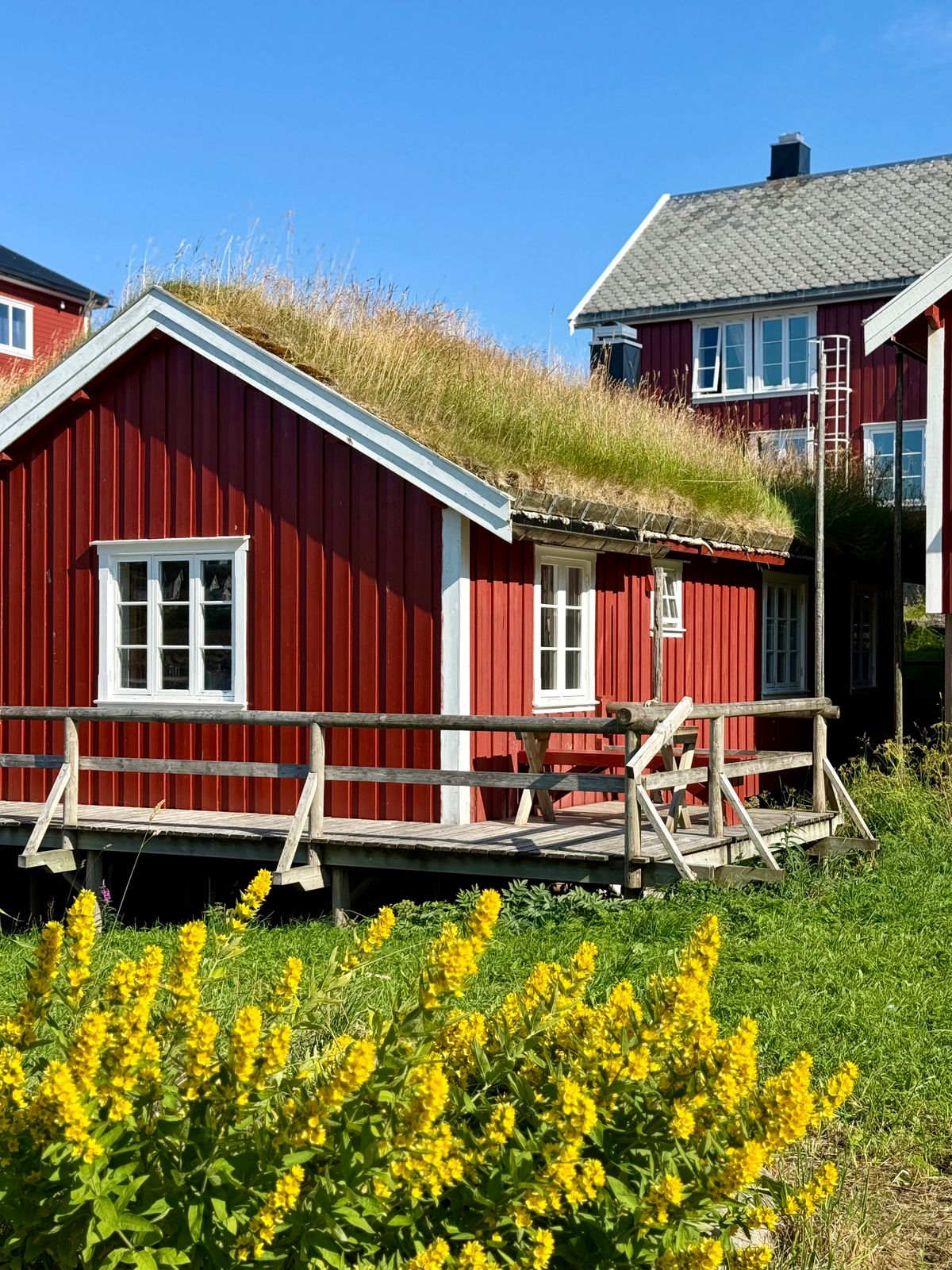
Even at modest depth, a living roof changes the thermal equation — and the aesthetic identity — of a small structure.
The Thermal Performance Nobody Calculates
Here is where the engineering gets interesting — and where most builders fall short.
A green roof's thermal contribution is not a fixed R-value. It is dynamic. The insulating capacity of the growing medium changes with its moisture content. Dry substrate insulates better. Wet substrate conducts more heat but activates evapotranspiration, which provides cooling. The system self-regulates: in hot, dry conditions it insulates; in hot, wet conditions it cools through evaporation.
Research compiled by the EPA shows green roofs can reduce cooling loads by up to 70% compared to conventional roof assemblies. That number is not theoretical — it is measured across multiple building types and climate zones. For an off-grid cabin relying on a limited photovoltaic array, a 70% reduction in cooling load is not an aesthetic choice. It is a survival specification.
In winter, the dynamic shifts. The growing medium and dormant root mass provide additional insulation above the roof assembly, reducing heat loss through the roof plane. The exact R-value contribution varies with substrate depth and moisture, but even an extensive system adds meaningful thermal resistance above and beyond what the insulation layer beneath provides.
And here is the detail that separates architectural thinking from construction thinking: the green roof does not replace your insulation. It supplements it while simultaneously providing stormwater management, extending the life of the waterproofing membrane by shielding it from UV degradation and thermal cycling, and reducing the urban heat island effect. You get four functions from one assembly. That is systems thinking. That is what an architect brings to the table.
The Stormwater Argument
For off-grid sites, stormwater management is not a municipal abstract — it is a site grading, erosion, and water supply issue.
An extensive green roof retains approximately 60% of annual rainfall. An intensive system can approach 100% retention during small to moderate rain events. That retained water either evapotranspires back into the atmosphere or can be directed into a rainwater harvesting system via overflow drains. In either case, the peak discharge from the roof during a storm event is dramatically reduced and delayed, which reduces erosion at downspout discharge points and can downsize your site drainage infrastructure.
For cabin sites on slopes — which describes a significant percentage of desirable mountain and forest building sites — controlling roof runoff is not optional. Concentrated water discharge at the foundation perimeter is the leading cause of crawl space moisture problems and hillside erosion. A green roof acts as the first line of defense, absorbing the initial rainfall and releasing the excess slowly.
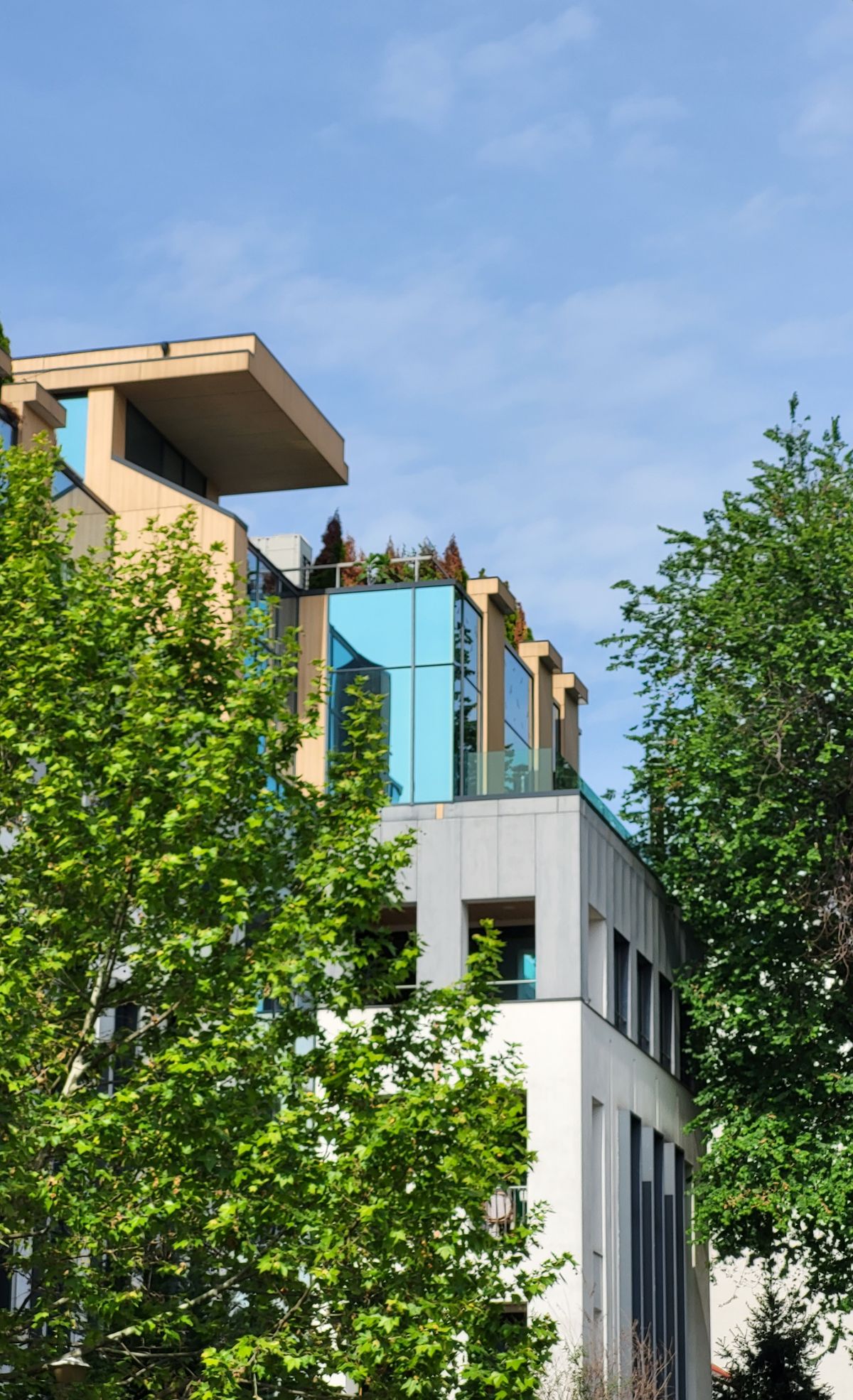
Modern green roof integration: the fifth facade as performance surface, not afterthought.
What Builders Miss — and Why It Matters
The most common failure mode in green roof installations is not structural overload. It is waterproofing failure due to inadequate detailing at penetrations and transitions.
Every plumbing vent, skylight curb, parapet wall, and roof drain that passes through a green roof assembly creates a junction between the waterproofing membrane and a vertical surface. These junctions require specialized flashing details — typically a minimum 8-inch upturn above the finished growing medium surface — that account for the unique loading conditions of a saturated soil layer pressing against them.
A conventional roofer knows how to flash a pipe penetration. But a conventional roofer may not account for the hydrostatic pressure of 4 inches of saturated engineered substrate — roughly 1.7 pounds per square inch — pressing laterally against that flashing for weeks at a time during a wet spring. The detail that works for a shingle roof does not work for a living one.
Slope is another critical variable. A dead-flat roof with a green assembly needs a different drainage strategy than a low-slope (2:12 to 4:12) design. Too flat, and you get ponding in the drainage layer. Too steep (beyond about 30 degrees for extensive systems), and the growing medium migrates downslope under gravity and rain action, requiring retention grids or baffles that add complexity and cost.
The architect's role here is not aesthetic. It is forensic. It is specifying the membrane system, detailing every penetration, calculating the structural load at saturated weight plus a snow load plus a live load factor, coordinating with the structural engineer, and producing drawings that a roofer can build from without guessing. That is the difference between a green roof that performs for 40 years and one that leaks in three.
The Part Most People Leave Out
There is a counterintuitive truth about green roofs that rarely appears in the marketing material: a green roof extends the lifespan of your waterproofing membrane by a factor of two to three.
A conventional exposed membrane — even a high-quality TPO or EPDM — endures daily UV bombardment and thermal cycling that can swing 100°F between daytime highs and nighttime lows. This thermal shock degrades the polymer matrix over time, leading to embrittlement and eventual failure. Most exposed single-ply membranes carry a 20- to 30-year warranty.
Bury that same membrane under 4 inches of growing medium and vegetation, and you eliminate virtually all UV exposure and reduce thermal cycling to a fraction of the exposed condition. Studies of green roofs in Germany — where the technology has been mandated in many municipalities since the 1970s — show membrane life expectancies exceeding 50 years when protected by a green assembly.
That means the green roof does not just provide thermal performance, stormwater management, and ecological benefit. It pays for itself by deferring membrane replacement. The additional cost of the green assembly is offset by the extended service life of the component it protects. On a lifecycle cost basis, a green roof can be cheaper than a conventional one.
But you will never see that calculation on a builder's estimate. Because builders price first cost. Architects calculate lifecycle cost. That is not a criticism — it is a different professional scope. And it is exactly why the choice of who designs your cabin matters more than most people realize.
The Specification Challenge
If you are considering a green roof for a cabin — whether a new build or a retrofit — here is the minimum your design professional should be addressing:
Structural capacity verified by a licensed engineer for saturated weight plus applicable snow load plus a minimum 20 psf live load. Waterproofing membrane specified for root resistance (ASTM E2398 or FLL guidelines). Drainage layer sized for the design storm intensity of your climate zone. Growing medium specified by a green roof supplier (not landscaping soil — the particle size distribution and organic content are completely different). Plant palette selected for your USDA hardiness zone, solar exposure, wind exposure, and maintenance access. Slope retention strategy if the roof exceeds 15 degrees. Irrigation plan for the establishment period (typically 1 to 2 growing seasons) if you are not in a climate with reliable summer rainfall.
If your designer cannot speak to every item on that list, your green roof is a hope, not a specification.
The Yūgen Studio and Studio ADU were designed with living roof integration as a core feature — not an afterthought. Explore the architectural plans that treat your fifth facade as the performance surface it was always meant to be: Yūgen Studio | Studio ADU.
0 comments