

Burned to Last: The Counterintuitive Building Science of Shou Sugi Ban
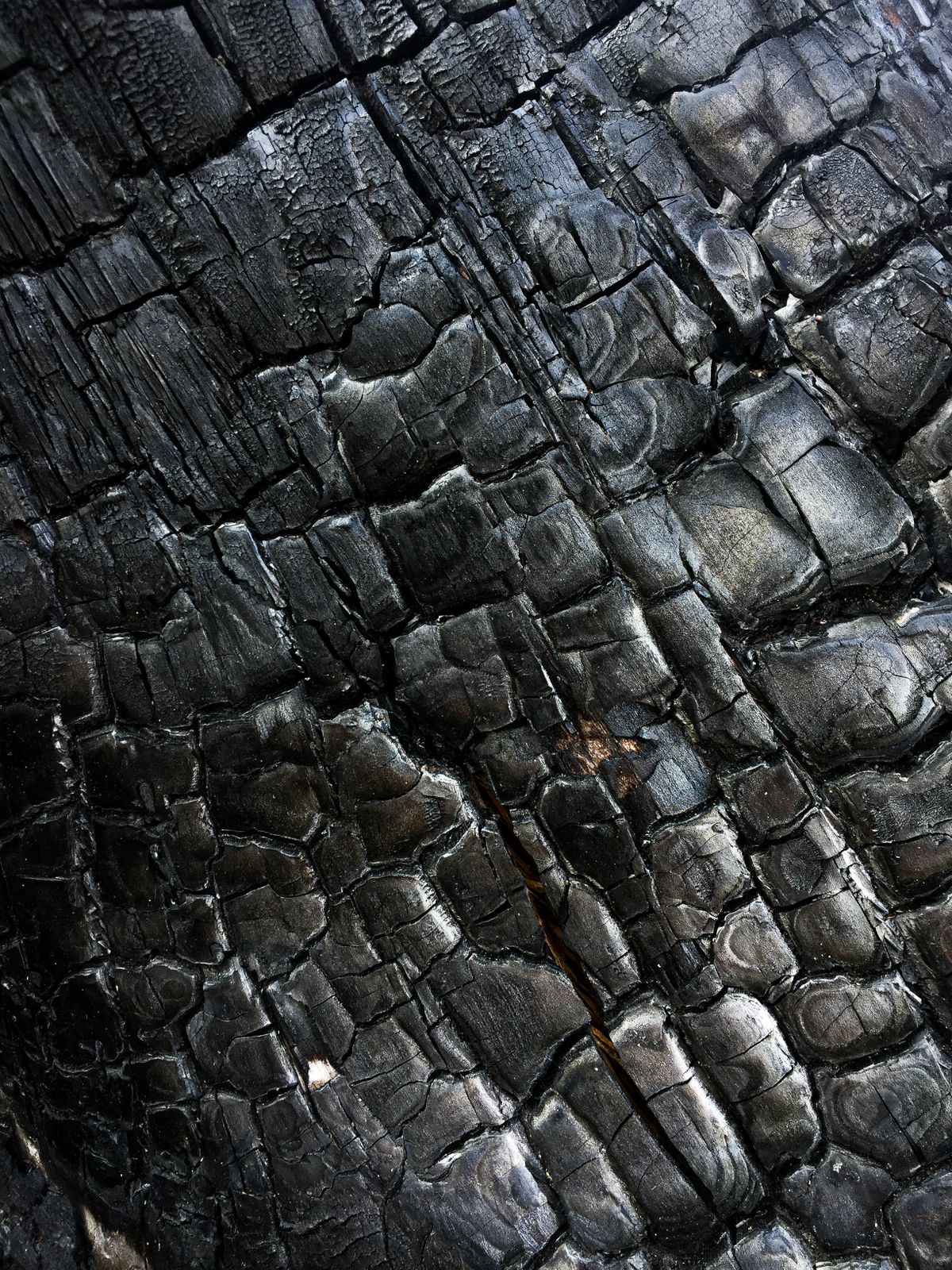
At some point in 18th-century Japan, a carpenter did something that should have ended badly. Faced with a post that needed to resist moisture, insects, and the inevitable decay that coastal humidity brings, he held a flame to it. Not briefly. Not cautiously. He charred the surface until it turned black and blistered and began to crack in the distinctive alligator-scale pattern that would come to define one of architecture’s most quietly radical cladding systems.
The post didn’t rot.
Decades later, it still hadn’t. Neither had the wall it was part of, nor the fishing storehouses in the Osaka region where this technique — yakisugi (焼き杉), charred cedar — was refined into a standardized building practice. While neighboring structures clad in untreated wood softened and grayed and began their slow surrender to fungal decay, the burned buildings held.
The question that building scientists are still unpacking is a deceptively simple one: Why does burning wood make it last longer?
What Happens in the Flame
Wood is approximately 50% carbon by dry mass, bound together with cellulose, hemicellulose, and lignin. These last two compounds are wood’s structural glue and, not coincidentally, what fungi and insects most readily consume. Cellulose is carbohydrate — essentially sugar from the perspective of a wood-boring beetle or a mold spore. Lignin is the architectural polymer that gives wood cells their rigidity. Both are biodegradable under the right conditions.
When a wood surface is exposed to flame at temperatures between 260°C and 340°C (500–644°F) for the right duration — typically 3 to 5 minutes per face in traditional yakisugi practice — a transformation occurs at the molecular level. The hemicellulose and a significant portion of the cellulose are pyrolyzed: thermally decomposed without full combustion. What remains is a surface layer composed primarily of elemental carbon and residual lignin char.
This char layer typically measures between 2 and 5 millimeters deep, depending on the species, moisture content of the timber, and flame exposure duration. And it is, in a meaningful chemical sense, already dead. There is no carbohydrate remaining for organisms to digest. There is no moisture pathway — carbon char is hydrophobic, actively repelling water rather than absorbing it. The char layer’s cellular structure has collapsed into a matrix dense enough that even UV radiation, which degrades lignin in untreated wood causing the familiar gray bleaching, has limited penetration.
In other words: the flame creates a surface that has, in effect, already undergone the decay process — pre-emptively, under controlled conditions, in the span of minutes rather than decades.
Three Centuries of Field Performance
This isn’t a boutique material with five years of case studies. Yakisugi has documented performance data spanning centuries, which puts it in a category occupied by very few modern cladding systems.
The exterior walls of traditional dōzō storehouses (土蔵) in the Kinai region of central Japan are among the best-documented examples. These structures, many built in the Edo period (1603–1868), used charred cedar or cypress for exterior surfaces in coastal and riparian environments where humidity is consistently above 70% year-round — conditions that would destroy untreated softwood within a generation. Surviving examples remain structurally intact, with char layers that have formed a secondary protective patina from atmospheric carbon deposition rather than degrading.
Contemporary laboratory testing, including work published through the Japanese Wood Research Society, has measured the effects more precisely. Properly charred Japanese cedar (sugi, Cryptomeria japonica) shows a dimensional stability improvement of approximately 40% compared to untreated stock under cyclic wetting and drying — meaning the wood swells and contracts significantly less with moisture fluctuations. This is directly relevant to cladding performance: most cladding failures in wood siding occur not from rot but from the mechanical fatigue of repeated movement against fasteners, flashings, and sealants. A material that moves less lasts longer, full stop.
Insect resistance data is equally compelling. Charred wood shows near-complete resistance to subterranean termites (Reticulitermes speratus, the dominant structural pest species in Japan) in laboratory exposure tests, with the char layer functioning as both a physical barrier and a chemical deterrent — the residual pyrolysis compounds are bitter and desiccating to soft-bodied insects.
The Three-Step Process (And Why the Third Step Is Usually Wrong)
Traditional yakisugi production follows a three-step sequence: yaku (焼く, to burn), migaku (磨く, to polish or brush), and nureru (塔れる, to oil or seal). Each step has a specific technical rationale that the contemporary Western revival of “shou sugi ban” frequently collapses or omits entirely.
Step one: burning. The char must reach a consistent depth. Traditional craftsmen test depth by pressing a thumbnail into the surface — if the char compresses but doesn’t flake cleanly, depth is insufficient. For contemporary applications, a 2–4mm char depth is the standard specification range. Shallower than 2mm and the layer is too fragile for durable cladding; deeper than 5mm and you begin to meaningfully reduce the structural integrity of the face grain. The flame source matters too: open propane torch burning, as used in many Western DIY applications, produces uneven heat distribution and inconsistent depth. Traditional practice used three boards bound into a triangular chimney, ignited from the bottom, allowing convective heat to char all three interior surfaces simultaneously and uniformly.
Step two: brushing. After cooling, the surface is wire-brushed to remove loose char particulate while retaining the intact char matrix below. This step is critical and widely misunderstood. The goal is not to achieve a uniform appearance. It is to remove unstable carbonized material that would transfer to hands, clothing, and adjacent surfaces while leaving the mechanically sound char layer intact. Over-brushing — which produces the dramatic silver-and-char reveal finish popular in commercial applications — actually removes material that contributes to weather resistance.
Step three: oiling. A penetrating oil (traditionally a plant-based oil, now commonly tung or linseed) is applied to the brushed surface. This step seals the remaining char against moisture infiltration at micro-fractures in the carbonized layer and stabilizes the surface against further oxidation. This step is routinely skipped in Western applications, substituting a matte black stain or paint that sits on the surface rather than penetrating it. The result looks identical for eighteen months and then fails dramatically by year three, which is why some contractors — and buyers — have wrongly concluded that charred wood cladding “doesn’t hold up” in humid North American climates.
It doesn’t fail because the concept is wrong. It fails because the process was truncated.

The Species Problem
Here is where the contemporary enthusiasm for yakisugi collides with North American timber supply, and where an architect’s material knowledge becomes non-negotiable.
Traditional yakisugi is performed on sugi — Japanese cedar (Cryptomeria japonica). Sugi has a cellular structure and moisture content profile specifically suited to the char process: relatively low resin content, tight grain, and an initial moisture content that allows the surface to reach pyrolysis temperature before deep combustion begins. It performs beautifully.
Western red cedar (Thuja plicata) and Douglas fir (Pseudotsuga menziesii, the most common framing lumber in North America) respond differently to the flame. Western red cedar’s high resin content causes localized flash-burning and uneven char depth — producing a surface that looks correct but has inconsistent structural integrity beneath it. Douglas fir has denser grain rings that resist pyrolysis and requires longer flame exposure, increasing the risk of deep combustion that weakens the board.
The most reliable North American substitutes, based on material testing and documented project performance, are thermally modified pine (treated in industrial kilns at 180–215°C before field application), Port Orford cedar (Chamaecyparis lawsoniana) for applications where Pacific Northwest sourcing is viable, or properly dried, vertical-grain white pine for applications where flame consistency can be controlled. Each requires a modified burning protocol. A specification that simply reads “charred cedar siding” on a set of construction documents, without species, char depth, brushing method, and sealing specification, will produce unpredictable results regardless of the contractor’s intentions.
The Maintenance Myth
One of the most persistent misconceptions about yakisugi cladding is that it is “maintenance-free.” This claim has been widely reproduced in architectural press coverage of high-profile shou sugi ban projects, and it is partially true in a specific context: a properly executed traditional yakisugi application, in a climate similar to rural Japan’s (moderate humidity, no sustained freeze-thaw cycling), with oil sealing maintained on a 10–15 year cycle, can perform for 80–100 years with minimal intervention.
In North American climates that include sustained freeze-thaw exposure — any location where temperatures regularly cycle below -10°C — the micro-fractures that form at the char layer’s surface from thermal expansion and contraction require resealing on a 5–7 year cycle. This is not a failure of the material. It is a maintenance schedule. The relevant comparison is cedar shake roofing (3–5 year maintenance cycle), painted wood siding (5–8 year repainting), or fiber cement (generally 15–20 years). By that measure, charred wood cladding is among the more durable and lower-maintenance options available.
What changes this calculus dramatically, however, is installation detailing — specifically the back-ventilation gap and the flashing at horizontal transitions. A charred wood cladding system installed tight against a moisture barrier without adequate back-ventilation will trap condensation at the char layer’s back face, where untreated wood is still present and fully biodegradable. The front face can be perfectly charred and sealed, and the cladding will still fail from the back. This is the single most common installation error in shou sugi ban systems, and it is precisely the kind of detail that only appears on properly developed architectural drawings.
The gap specification matters: 19mm (¾”) is the minimum functional back-ventilation space. The geometry of the battens, the drainage plane, and the continuity of ventilation from base to peak is a systems problem — not a material problem. Getting the char depth right and then installing it incorrectly is like buying the most durable tires available and then installing them with the wrong torque on the lug nuts.
What It Tells You About Any Cladding System
Shou sugi ban is worth understanding in detail not just because it is one of the most beautiful and durable cladding systems available to a contemporary cabin builder, but because it illustrates a principle that applies to every material decision in a building envelope: the specification gap between what a material can do and what it will actually do in your assembly is where buildings fail.
The material itself has a three-hundred-year performance record. The failures in contemporary applications are almost entirely failures of documentation, specification, and installation sequence — the exact things that a properly developed set of construction drawings is designed to prevent. A contractor who has installed shou sugi ban successfully three times will bring valuable practical knowledge. But without drawings that specify char depth range, species, brushing method, back-ventilation dimension, sealing product, and flashing geometry, the fourth installation may look identical on day one and fail by year five.
The building science isn’t complicated once you have it. But you have to have it first.
The Yugen Cabins Smokey Cabin 2.0 was developed with exactly this kind of material specificity built into its construction documents — exterior detailing that accounts for cladding system performance over decades, not just months. If you’re drawn to the aesthetic and durability of charred wood in a compact, high-performance cabin package, take a look at the Smokey Cabin 2.0.
0 comments